


Australia’s gambling market is projected to generate US$15.88 billion in revenue in 2025, and a meaningful slice of that revenue is recycled through bonus structures designed to attract and retain players. I have dissected hundreds of bonus offers across PayID-accepting casinos, and the pattern is consistent: the headline number grabs attention, and the terms underneath determine whether the bonus has any real value. Understanding these mechanics before you deposit is the single most effective way to protect your bankroll.
PayID adds a specific wrinkle to the bonus equation. Because deposits arrive in seconds rather than hours or days, time-sensitive promotions become accessible in a way they are not with slower payment methods. But speed of deposit does not change the mathematics of the bonus itself. This guide breaks down the main types of bonuses you will encounter, what the fine print actually means, and how to evaluate whether an offer is worth your deposit.
Types of Bonuses Available at PayID Casinos
I remember the first time I mapped out every bonus type at a single operator. The welcome page listed a “300% match plus 200 free spins” package, which sounded enormous until I read the terms. The match was spread across four deposits, each capped at AU$250. The free spins were released in batches of 20 per day over ten days. The wagering requirement was 40x on both the deposit and the bonus combined. The headline was marketing. The terms were the product.
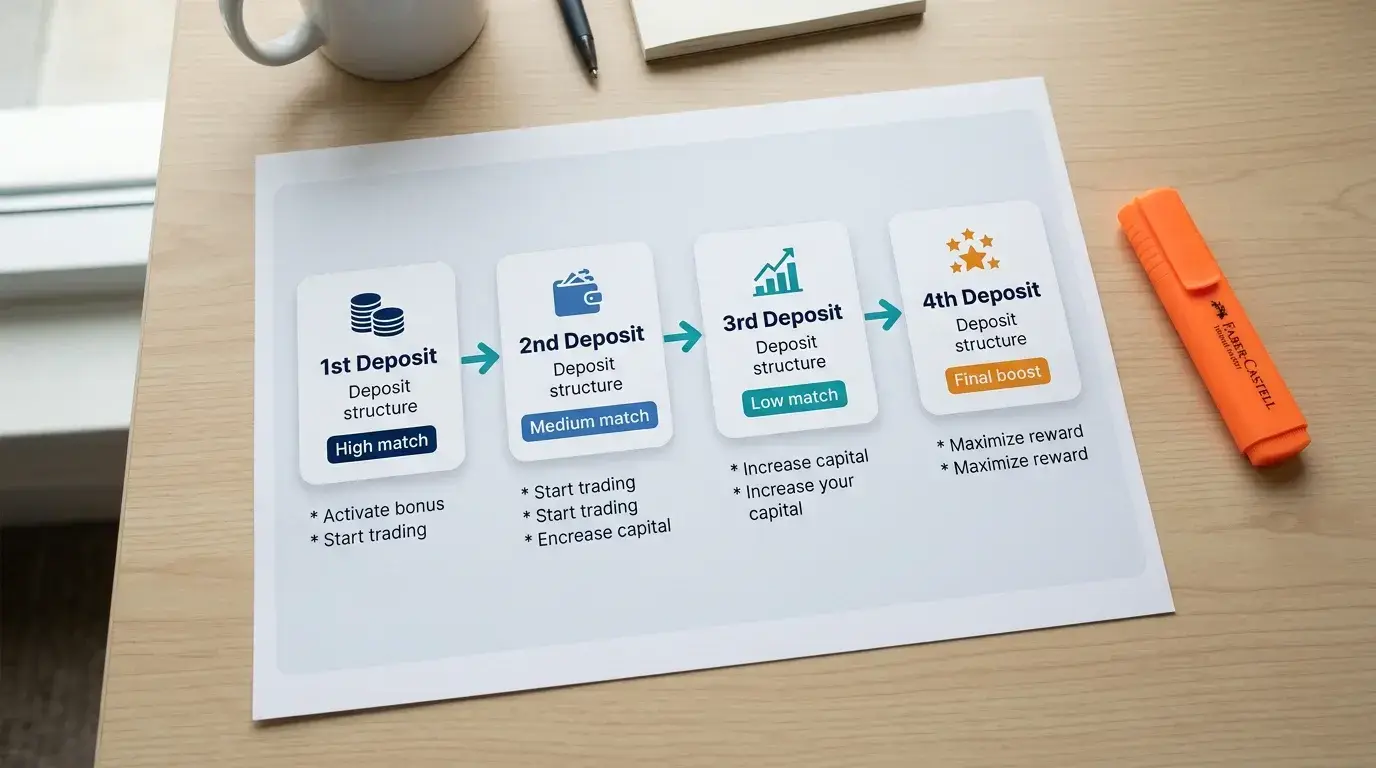
Welcome bonuses remain the most common type at PayID casinos. A deposit match — 100%, 150%, 200% — adds bonus funds to your account proportional to your first deposit. If you deposit AU$100 with a 100% match, you have AU$200 to play with. The match percentage is less important than the wagering requirement attached. A 100% match with a 25x wagering requirement is more valuable than a 200% match with a 50x requirement, because the cost of clearing the wagering is lower relative to the bonus received.
Free spins are the second major category. These come in two forms: tied to a deposit (deposit AU$50, receive 100 free spins on a specific pokie) or as a standalone no-deposit offer (create an account, receive 20 free spins). The value of free spins depends on the bet size per spin, the RTP of the assigned game, and any win cap applied to the results. A set of 50 free spins at AU$0.20 per spin on a 96% RTP game has an expected value of AU$9.60 before any win cap — far less dramatic than “50 Free Spins” suggests.
Cashback offers return a percentage of your losses over a defined period. A 10% weekly cashback on net losses up to AU$500 means if you lose AU$500 in a week, you receive AU$50 back. These are typically lower-maintenance than match bonuses because they do not require wagering on the cashback amount, though some operators do attach playthrough conditions. For PayID depositors, cashback offers are straightforward because the deposit timing does not affect the cashback calculation — only your net losses during the eligible period matter.
Reload bonuses target existing players making subsequent deposits. They usually carry lower match percentages (25% to 75%) but sometimes come with lower wagering requirements than welcome offers. Loyalty programs and VIP tiers add another layer, offering periodic bonuses, personalised offers, and sometimes faster withdrawal processing. Since more than 11% of Australian adults now participate in online gambling within any six-month period, operators invest heavily in retention mechanics to keep existing players active.

How to Read Bonus Terms Without Getting Burned
Every bonus has a terms page, and I have never encountered one that was designed to be easy to read. The critical terms are usually scattered across paragraphs of legal prose, and the most important numbers are rarely in the headline. Here is the order I read them in, and the specific numbers I look for.
Wagering requirement comes first. This number — 25x, 35x, 45x — tells you how much you must wager before bonus funds or winnings become withdrawable. A 35x wagering requirement on a AU$100 bonus means AU$3,500 in total bets. At a 4% average house edge on pokies, the expected cost of clearing that requirement is AU$140. If the bonus itself is worth AU$100, you are paying AU$140 to receive AU$100 — a net loss of AU$40 in expected value. Bonuses with wagering requirements above 35x are rarely worth taking from a pure mathematics perspective.
Game weighting is next. Pokies almost always count 100% toward wagering. Table games count 10% to 20%. Live dealer games may count 0%. If you primarily play blackjack, a bonus with a 35x wagering requirement effectively becomes a 175x to 350x requirement because only a fraction of each bet counts. The no-wagering alternative eliminates this complication but introduces its own set of restrictions.

Maximum bet during bonus play is a trap clause. Most bonuses cap your bet at AU$5 to AU$8 per spin while wagering bonus funds. Exceed this limit and the operator can void your bonus and any winnings derived from it. I have seen players lose significant balances because they did not know this cap existed. It is usually stated in the terms but never on the bonus banner.

Win caps limit how much you can withdraw from bonus play. A AU$5,000 win cap means that even if you hit a AU$50,000 jackpot while playing with bonus funds, you only keep AU$5,000. Some operators set this cap much lower — AU$500 or even AU$200 on free spin winnings. Always check this number before assuming a bonus could generate a significant payout.
Expiry periods define how long you have to meet the wagering requirement. Seven days is common, 30 days is generous. If you do not clear the requirement in time, the bonus and any associated winnings are forfeit. PayID’s instant deposit speed helps here — you can claim a bonus the moment it becomes available without waiting for payment processing — but the clock starts when the bonus is credited, not when you start playing.
Finally, payment method restrictions. Some operators exclude certain deposit methods from bonus eligibility. PayID is generally accepted for bonus claims at operators that list it as a deposit option, but verify this in the terms before depositing. Nothing is more frustrating than making a PayID deposit specifically to claim a bonus, only to discover that the bonus is restricted to card deposits or e-wallets.